Friday, June 20, 2025

Seeing The Light - Health and Detecting

 Metal detecting, and being active in the hobby, usually bodes well in the health department for most people, especially senior members of our society, whose chance for physical activity erodes as joints get sore and inflamed while opportunities for activity diminish into watching a flickering screen in an air-conditioned cell.  Since I am quite health challenged myself, with cancer, heart disease, Diabetes, and a poor attitude, I have recently been in the intensive care unit at the VA a few weeks ago with a festering heart issue, which called for the stopping of my heart, then restarting it again to get it back into a healthy sinus rhythm, which they did, or I wouldn't be writing this. As a result, I usually am interested in any advancements in health science or medical devices that may help to keep me one of the most annoying treasure hunters to have a continuing presence among the hordes of today's treasure hunters. My interests often take me to alternate publications like NEXUS, one of my favorites, with it's tell-it-like-it-is science articles. And here we find an interesting item on the science of 


sunlight on the human body. Not just any sunlight, but the early morning, low ultraviolet "red" light of the morning sun. This type of light helps jump-start your day. Who takes advantage of this state of atmospheric affairs? Why early morning east-coast beach hunters, be it on the sand or in the salt water, you are absorbing some of the best and healthiest photonic wavelengths according to neurosurgeon Dr. Jack Kruse (NOT the inventor of the Nokta Kruser metal detector!) in his NEXUS article "The Quantum Light of Life"

In the good doctor's view, his audacious claim is that light, water, and magnetism (all components of beach detecting) - not diet or drugs-drive life's engine. We are actually solar-powered creatures and our disconnection from natural light, coupled with our constant emersion in 21st Century artificial "blue" light, is the root of modern chronic disease. So not to put too fine of a point on it, metal detecting, in all probability, is one of the healthiest hobbies, especially in regard to sand and water hunting at the beach. Around noon time the sun is now putting out IR (Infared) and UV (ultraviolet) radiation which is a driver of improved metabolism and immunity. Just the opposite is the dreaded "blue" light, artificial LED or plasma illumination that actually saps our health, damaging our mitochondria and other aspects of our sunlight-based health. And everyone is continually bathed in it from the cellphone, computer, tablet and television. And a lot of folks who don't get out of the office and into D65 (daylight) illumination may be paying a price for it later. Of course, you're going to say, "But Sunlight causes cancer!" and you would be right, but that would be sunlight in excess, which younger people can tolerate pretty easily, but us older folks can get a case of melanoma of the skin if we go unprotected too long. It's a double-edged sword we are working with here. Despite that, my own doctors continually urge me to get more sunlight. 

Couple these aspects with the otherwise normal choreography of bending, stretching, and other mechanical aspects of using your muscles and tendons digging and scanning and you have a pretty complete workout of pretty much everything that matters. We've had several members of our metal detecting club who have hunted well into their 90's, and several others still hunting regularly into their early to mid 80's and a plethora of other members hunting at various other senior age groups. To say metal detecting at any age can be a healthy pursuit is quite true and can be an advantage over other more sedentary hobbies of the less physical kind. And the treasure aspect is a motivating factor to keep you interested; seeing an 18K gold ring in your scoop is a massive rush! Just remember to hydrate, hydrate, hydrate before a case of dehydration takes you down, literally! At any rate, here is wishing you good luck and happy hunting, as summer officially starts in a few hours!


Wednesday, December 4, 2024

Metal Detecting - Here in the Future

As one who has lived through a good portion of the metal detecting hobby, about 60-years of scanning terra firma from the golden summer of 1965. I was armed with an unstable BFO (Beat Frequency Oscillator) metal detector built from plans laid out in Popular Electronics magazine and cobbled together from old television and radio parts, including a search coil made from the antenna windings on fiberboard, torn from  back of an extremely old AM radio. the handle off a push-broom and a birdhouse as a control box. My very first find was a severely flattened FALSTAFF BEER can in the front yard of our South Florida home. It was 2" deep, and my father was extremely surprised when my home-grown instrument indicated it was there! Flagstaff quit distilling beer in 2005, founded in 1845.


But now, I am metal detecting here in the future, with instruments we could never have imagined in our wildest dreams! Metal detecting has long-since come to the masses which has been a double-edged sword in many respects. And like people who are enamored by Star Wars or The Matrix, sometimes have to be reminded, it's just a movie!  Well in the same regard, metal detecting is just a hobby! 
One that will become extinct in the long term if the practitioners don't start using a little sense of purpose and reduce the drama. 

There is no crying in baseball and there is no drama in metal detecting. And one of the best/worst things to happen to the hobby is social media where newbies can get either fantastic assistance or amazingly poor advice or a little of both. The time of year is here where thousands of newbies will be excitedly waiting to hit the beach or park with their shiny new metal detectors and swinging the search coil 3-feet off the ground in an exaggerated golf swing. There are no schools for metal detecting, only word of mouth and the good Samaritan detectorist who will help when they see this sort of thing. People of all stripes in the hobby will be offering as much information and disinformation as they always do. And they will be either protecting their interests in the hobby or welcoming the newcomers with open arms. There are two theories here. The first one, as long as I have been in the hobby, has been that the more responsible people involved in the hobby, the more voices we will have in defense of the pastime, which is ALWAYS under attack by officials. And sometimes with good reason. 

The second is to ignore them and their questions and pleadings, amounting to the normal range of errors and mistakes from digging where they shouldn't to leaving gaping holes in a manicured park. Not good for the hobby at all, and an all too often occurrence. I think the basic solution to this is to join a local metal detecting club. Don't have one nearby? Start one! Grab your buddies and find a cheap meeting place, review established club practices from other groups and get organized. Offer your services to local law enforcement evidence hunts and do good whenever you can! I belong to the Central Florida Metal Detecting Club, just now passed its 50th anniversary here in the middle of Florida. It is a SERVICE oriented club, with an extremely competent and dedicated group of people, striving to help others learn the technical and ETHICAL side of the hobby. And, in this way, keep it out of the trash bin of history. One of the main reasons we join a club is for the camaraderie and that oh-so-hard-to-find treasure, FUN! So, when you run into a fledgling detectorist on-line, in a group, or on a beach, offer to take them on a detecting adventure and show them the ropes. Most of all, remember to pay it forward!

Sunday, April 28, 2024

Video Advice - Detecting Opinions

 I was surfing the net the other day when I decided to go tubing amid the video rapids of YouTube. Now, this is the usual place recommended on social media metal detecting groups when someone has taken possession of a new or used metal detector and is just starting out in the hobby. It is an established fact, that humans find watching a video a lot less taxing than reading bland, boring operating instructions and even harder to park it in memory. And metal detectors, being a bit technical in nature, can have a big learning curve if you bought a top-grade machine. And again, usually one does not start out in this rather expensive pursuit with the purchase of an expensive top-of-the-line detector. But some do and then

dump the hobby as too difficult, too complicated or become a mud-covered treasure wizard! Absorbing a bit of the knowledge required to operate these advanced 21st Century top-of-the-line devices is not particularly easy and can require quite a bit of reading; going over manuals as well as reviewing factory updates to its little computer brain to endow it with more and more varied functions and abilities. All this being said leads me to an issue hiding behind even the clearest 4k screen. ANYONE can put out a YouTube video. So be very careful what you base your decisions on after viewing.

This topic was pretty much brought on after watching a YouTube channel with the detectorist comparing two closely matched, high-end detectors. Problem was the host didn't really know what he was doing, and he kept making errors in the comparison with the other equipment that he obviously had more experience with. He never once ground-balanced the competing machine, complaining how unstable it was, and did not select the correct operating mode for the conditions. I have seen similar YouTube detector scenarios with numerous variations on this theme. Just because you have flashy intro graphics and music, does not mean you are an expert in anything. I once saw a post on a Facebook Metal Detecting group belittling a particular brand of metal detector as "worthless" and poor operating functions. I happened to know this person personally, and that they had an accumulated time of about 4-hours on this equipment and had owned it for 3-weeks and had NOT read the manual or received any assistance from a more experienced hunter. 

Someone looking to purchase a detector would recoil in horror and cross off a very, very capable and reasonably priced piece of gear! This is almost always the response to someone asking a valid question about a detector they either own or planning to purchase "Watch YouTube!!" There actually ARE quite a few excellent and well-seasoned detectorists running YouTube channels, with good information with well stocked facts about detector operations and other aspects of the hobby. My advice is to READ the manuals carefully and SELECT metal detecting channels on the Tube carefully and just be aware that video advice is not always good advice. Happy Hunting and Good Luck in the field! 

Saturday, January 27, 2024

Cherry-Picking - Turn Up That Discrimination

Metal detecting can go from being a fun, relaxing hobby, to a sweat-laced competition and obsession played out on social media, thoroughly peppered with drama. Most people who "always wanted a metal detector" here in the 1st quarter of the 21st Century are about 50-years too late. More and more regulations, usually brought on by the blatant misbehavior of those that came before you, are limiting areas to detect, as well as the blatant mistake Florida made inviting the great throngs of the unwashed to invade our state after they broke their own. This has created sort of a land-rush in Florida, with historic and non-historic buildings, land, communities and nature areas being overrun by developers, bulldozing those same areas into submission and removing them from the sphere of our casual pastime and enjoyment, as concrete is poured into every nook and cranny.

In kind of a round-about way, this gets me to my point. As areas to hunt decrease, the quality of hunt areas decrease, i.e. more and more trashy areas are becoming the only places left to hunt. When you start metal detecting, a great hush will fall everywhere as the gods of metal detecting tell you, in no uncertain terms, that it's a technical sin to use any more than a smidgen (if even that!) of discrimination on your machine. Others in the hobby will tell you in a loud voice, you may (you may) MISS a small, teensy, shrimpy little gold band if you use too much discrimination!!!! (OMG!!!) But, as usual, time is not on your side and digging railway-carloads of junk and trash so you don't miss ANYTHING is a losing proposition. Metal detecting is not called "cleaning parks" for a reason, and that's not what you signed up for. Practicing this sort of thing is sure to frustrate you and bore you to tears, and usually results in you taking up golf again, using your metal detector as a putter.

Cherry-picking is the term used in the hobby when you crank the discrimination control up a bit more than usual, maybe even more than that. And you may not find that skinny gold ring, but that's not to say there are no other rewards for this kind of behavior. You will start finding relics and antiques that were masked at lower discrimination by the layers of bottlecaps, pull-tabs, foil and other junk like a metal overcast. Sure you are going to miss some stuff, but you are going to find some GOOD stuff for a while, the stuff that makes metal detecting the fun thing it was supposed to be. Now there are those that will disagree with me, but they also cherry-pick when the junk get's thick! Hey, that rhymes! As always, do what YOU think is best, and most important have FUN doing it!


Sunday, December 31, 2023

So it Begins Again - Welcome to Metal Detecting!

 I was going to pen this in a slightly glib manner, but after a bit of re-thinking, I figured that was the easy way out. And I am not known for taking the easy way out, ever! Tomorrow, when 2024 surfaces like a damaged U-boat, it will mark my 60th anniversary in the metal detecting hobby. I built my own primitive, feeble, beat frequency oscillator detector (BFO) out of spare parts in 1964 when I was little more than 13-years old. It was the best machine for finding flattened beer cans ever made and I've been beeping ever since. So, I feel I have a little skin in the game, enough to offer advice and criticism thereof. Just to set a baseline here, "So it begins again..." refers to the real fears long-time detectorists harbor as they realize thousands of metal detectors will soon be gifted to thousands of would-be hobbyists on December 25th. Their fears are usually borne out as the Social Media Metal Detecting Groups feel the surge immediately, as membership suddenly swells the day after Christmas and will keep on for several weeks after. Comments like "I always wanted to do this!" and "I'm NEW to the hobby and would like to learn more about it!" and hundreds of variations of this theme pour into the membership request slots for Administrators to ponder.

The really best comments that fill me with hope are from new users that want to learn more about the hobby, presumably and figuratively, and learn the best way to practice it. I salute those who are here on a mission of ethical and moral exploits in a hobby that has a dearth of both. The most important ethical point I can possibly make, from Matthew, in the Bible, "All things therefore whatsoever ye would that men should do unto you, even so do ye also unto them" Basically treat everyone with respect, and respect is doing what is right. Metal detecting in itself has the potential, like anything else, to do great good (returning lost items for folks) or great evil (damaging property, leaving holes and dug garbage everywhere) and you are the deciding factor!

As far as your new hobby goes it can be as simple as hunting a beach or park or as complex as hunting for battlefield relics or lost treasure at sea; And, like Doc says in "Back to the Future," it's whatever you want to make of it! The technical specs, operating procedures, additional tools and best practices can be found most anywhere on the world-wide web, as well as the worst practices, like disturbing war graves, or digging up a cemetery! This brings me to the greatest benefit you could take advantage of as a new player in this awesome hobby which would be to join a local metal detecting club. There you will find fast friends who share your interests, can help you "learn the ropes" hands-on, and mentor you through a hobby that will bring you years of health and enjoyment. Just remember, ethics come first, detecting second!

Good luck and happy hunting to you all!


Saturday, September 30, 2023

Treasure Hunting & The Way of Research

The modern metal detectorists (treasure hunters) seem oddly uninterested in finding treasure: "I know I'm never gonna' get rich!" or "We're not really going to find anything," they all say, quite modestly. I hear it all the time. My question has always been, WHY NOT?? When I started treasure hunting (with a metal detector) almost 60-years ago, we literally thought anything was possible. An old cache of buried confederate rifles, maybe even some of that civil war gold hidden somewhere near Gainsville by the fleeing Confederate soldiers. Scuba diving for sunken treasure still trapped aboard fleets of sunken Spanish Galleons, covered in sand. Literally nothing was off the table...and it was always GO time! 

Treasure, fresh off the Atocha in 1987 - We got a free Preview!

Our equipment was not the most advanced, our gear was not top-of-the-line, but we had something you cannot buy; a spirit of adventure and we were not afraid of hard work. And treasure hunting is hard work! And some of the hardest work is research. No computers in the 1960's 1970's or a good part of the 1980's and 90's. Back then it was visiting archives and libraries and museums, sitting in a chair for hours reviewing endless loops of microfilm, flipping thru coffee-table sized books of 19th century hand-drawn maps and charts. Reading first-hand, historic accounts and unpublished papers. And even today, that skill may still be needed!

One project I accidentally stumbled upon was the result of reading an old hardcover book published in, I think, 1920 or so, about Florida's 19th century "cracker" cowboys. The name derived from the whips they cracked while herding cattle from Arcadia down to the cattle yards at Punta Rassa on the Gulf of Mexico. The rub was this: they were selling the cattle to Cuba and were paid in gold double-eagles, otherwise known as 20-dollar gold pieces. Once they were paid, the cowhands filled saddlebag after saddlebag with gold specie, went to the local bars and saloons, got drunk, beat each other up, then in the early morning light (with cuts, bruises and a pounding headache) headed back northward upon the Caloosahatchee trail toward home. 

It took several days, and the cowboys made camp several times on the journey north. With leather saddlebags heavy with gold, they would have removed them at night while the animals grazed and slept. Who is to say, but a few coins may have jolted out when the bags hit the ground, or spilled out, unnoticed when they were slung back over the horses' backs? The book went on to say when the cowhands reached Arcadia, they dropped the saddlebags on the ranch house porch. The account went further to say that a couple of gold eagles were dropped into a cracker tin as a toy for the younger kids. They said the gold coins colliding in the box made "a singular ringing sound" that the children liked. A gold baby rattle! Now that is where I left the project years ago. I contracted several forms of cancer, endured chemotherapy, underwent cancer surgery, got diabetes along with covid-induced heart problems. My elaborate treasure hunting expedition days are over. But maybe yours are not!

Several of those gold coins would be worth a pretty penny with gold prices as they are, in addition to the collector's value of a key date double eagle. You pick up the trail from here. You would need to research where the exact route of the Caloosahatchee trail lay in relation to today's current geological layout here in 21st Century Florida. They would usually camp near water, so estimating by researching how far they could travel without cattle in a day, would give you some idea of where they made camp. Check maps for lakes, streams, rivers, etc. Get GPS coordinates of key landmarks on Google maps. Second, start researching the location of some of the original cattle ranch houses in Arcadia, Florida. The front porches would probably have gaps in the floor and coins could easily slip thru, especially if the kids had removed them from the tin box. Or they may still be in the tin box, now buried and forgotten near the house. And first and foremost, keep your mouth closed concerning your ongoing project!

See how this sleuthing thing works? One question begats another and another. Make a folder, collect documents, photographs, maps, scans, notes, calculations and write down more questions that need answering! When you have answered them all, it is time for your hand-held GPS and your metal detector to join the hunt. Good luck and happy hunting!

Friday, September 15, 2023

Metal Detecting Security - Defend Yourself


Our country is becoming more dangerous every day, and regardless of your politics, it probably affects you and your hobby more disproportionally (big word there) than most people. The reason being, of course, you are out and about a lot, and more exposed to those interested in doing you dirty, or doing you in. The common citizen's biggest security threat is themselves; head down and locked 85 to 95 percent of the time, head stuck in their little plastic screens. Situational awareness is out the window. A large gorilla with a ball bat could easily sneak up on them. Metal detectorists have a similar problem; head down and locked attentive to their VDI panel, their sweeping coil, or on their knees, head down and digging the target, and not paying attention to the world around them. This may be their last mistake. 

As a treasure hunter you drag around thousands of dollars' worth of expensive, high-tech equipment. And nobody notices anything "expensive" more than a criminal. And for some reason I have not been able to fathom, Florida recently invited every criminal, thug and Ne'er-do-well to join us here in paradise so chances are good this will get worse before it gets better. I can relate a true story from several years ago. A woman went for a late afternoon water hunt at a public beach that had been cleared after a sudden thunderstorm. Very few people anywhere, but she still waded out and was hip-deep metal detecting. She was water hunting intently, then suddenly noticed some guy pacing her on the beach. No one else for miles. He yelled a few things at her, but the waves drowned out his speech. She was getting nervous, and started wading back to her car, but the man kept pace with her, as she struggled against the current with her gear. 


1.59-ounce pressurized pepper spray


She was getting desperate, and cold, and it was getting dark. The guy stood stock still and just stared at her. Her phone was back in the car, a quarter mile away, while the man just silently glared at her, glancing left and right once in a while. Suddenly a grumbling noise came bouncing up the deserted, darkening beach, the bright headlights illuminating the sand. The man quickly jogged away as the beach patrol pulled up with two lifeguards aboard. They asked her if she was okay and loaded her and her gear aboard. They took her back to the parking lot and her car. She told them about the man, and they looked for him on the way back, but he must have raced up one of the beach access points, because he was nowhere to be seen. She was safe and sound and LUCKY because who knows what might have happened if the lifeguards had not arrived? 

Lesson one, don't hunt a deserted beach alone, especially at night. Unless you have a buddy with you. And carry your cellphone in a waterproof case on a lanyard. And even with a buddy, have lethal or non-lethal defensive weapons with you for protection if you feel you may need them. Unlike most of the states in the Union, who do their level best to make it illegal to defend yourself, Florida allows citizens to legally carry, concealed or unconcealed, a pepper spray or pepper jell as long it does not exceed 2 oz. You can pick one up for around $14 or so. Learn how to use it online, many videos show you how. And PRACTICE using it on a target, as most will shoot 15 to 20 feet. 

My ex-policeman friend says draw a face on a paper plate, stick on a post or a fence and practice spraying a chemical-loaded figure 8 across the eyes, nose and mouth. Do it again, if necessary, especially in the mouth!  Another handy deterrent is an eight-ounce portable air horn. It fits in your pocket and will actually hurt your ears when you press the button! And that's with it pointing AWAY from you! Imagine the effect in FRONT of the horn? And it will get quick attention. You can pick one of these little noisemakers for about $7 at any sporting goods store. Recently, Florida passed a law allowing anyone (with certain exceptions) to carry a concealed firearm without a permit. Of course, it's a good idea to get a CCW permit anyway, take firearm training, go to a range to practice and know what you are doing and what the law is.

An air horn will blow the ears off of an attacker and get attention real quick.


Last but not least is set up a routine while you are hunting, by making it a habit to keep your situational awareness updated frequently by keeping you head on a swivel. If a situation seems to be developing, or you see something sketchy, LEAVE IMMEDIATELY!  It would be, in my opinion, in your best interest to remove yourself from any situation that may force you to use deterrents of any kind. Being thrown in jail for unprovoked assault is not going to be pleasant. These same practices will work also in parks and fields unless there is a posted sign restricting these types of deterrents. You must comply with all laws and regulations when using these devices, and this is simply information on devices useful for defending yourself in metal detecting situations. I am not a lawyer, and it is your responsibility to use this information legally and responsibly! Stay safe and stay aware!

Tuesday, September 12, 2023

The Coil Cover Game - A Revew


I have watched this phenomenon for a very long time in the metal detecting hobby, and I still occasionally go off a cliff over it. My wife says "Let it be..." but I can't! Coil covers drive me crazy!!! Especially nowadays when they are pretty much akin to useless but are still recommended by those who theoretically are in the know; especially on social media (is there any other nowadays??) platforms.

Now I am sure there will be those who would strongly disagree with me, but that's because they have been subliminally subdued into accepting the logical-sounding argument that coil covers act as a needed barrier between the outer world and your EXPENSIVE and easily damaged coil! And that actually WAS the case many, many years ago! Back then, in the 1970's and 1980's, we used co-planar coils that looked like fat serving dishes, we slang-termed them "dinner plate coils" which were made of thin injection molded polyethylene or polypropylene. 

The skin was very thin and easily worn through, especially if you were beach hunting in areas that had a rocky, gravel- strewn beach, like England, California, Oregon or Washington. Very tough on coils bottoms! The plastic coil covers were really a necessity back then...which were also easy to wear through, and you'd go through at least one or two a year if you were a prolific hunter. But time moves on. Here is 2023 our technology has advanced as quickly as our society has declined, and today's coils are made of practically miraculous materials that renders the coil's physicality almost indestructible! 

The coil's electrical / electromagnetic infrastructure is imbedded in an epoxy resin matrix. This material is hard...very hard! Here are some of its properties: 

  • High tensile strength ranging from 90 to 120 MPa
  • High tensile modulus ranging from 3100 to 3800 MPa
  • High glass transition temperatures (Tg) ranging from 150 to 220 °C
  • High compression, resilience, flexion, and tensile strength
  • High resistance to degradation over time

The tensile strength of epoxy runs from 90 to 120 Megapascals, which means a PSI factor (covert pressure) at its highest is over 17,000 pounds per square inch! And at the lowest end of the range, tensile strength is running around a little over 13,000 pounds per square inch! I ran my 11" coil on my Minelab E-Trac continuously on the beach, in parks, at construction sites and everywhere in between without a coil cover for 7-years with little to no wear on the coil. Here is a picture of the actual wear the epoxy resin incurred on the bottom of the coil.

.
Unprotected 11" coil bottom after 7-years use in all environments
And of course, I'm talking every day intended use here. Thus, there is really very little need for a troublesome coil cover any more, and of course this is from my perspective, while you may disagree.

Now, my opinion of course, of the whys and wherefores of the continued recommendation for using them? Despite the fact they fill up with water, sand, things you don't wanna' know about, they become loose quickly, fall off, cause target falsing and are miserable to clean, as well as reinstall? Money, pure and simple. Cash on the barrelhead. Moola and mucho denero! A coil cover can cost you anywhere from $15 up to $40 and whoever thought of this is a bona fide genius! 

I was a plastics engineer for a number of years and I can tell you they cost almost nothing to make and are pure profit all the way! I don't begrudge anyone using one, and as a recent case in point over the last few years, something that really does not do anything and is a royal pain in the keister, yet makes certain folk feel safe, then so be it. Everyone has the freedom to choose, I'm just trying to point out the man standing behind the curtain. Cheers!


Thursday, July 27, 2023

Detecting Dishonor - An Ill Wind A 'blowing

As usual, I gotta get something off my chest about this expanding, but morally declining, hobby. There is a saying that postulates "Man carries the seeds of his own destruction" which is not dissimilar in the way the metal detecting hobby also carries the same seeds of its own destruction. Worst of all in my book, is the out and out theft of jewelry that is reported missing, usually in desperation, by an individual who put too much faith, I'm sorry to say, in the honor of a certain class of detectorists.  


Social Media's involvement in this enterprise is a double-edged sword.  One side offering hope and assistance to the owner, while the other has turned to sabotaging the same, using the location knowledge as an advantage to thrust the criminal agenda of thieves, and crooks forward. A sweet song of easy money, metal detecting predators are always hiding in the digital shadows, looking for a quick, easy score of gold in any form. Once the Social Media word is out, they are already in motion, even while the would-be recovery team is still discussing among themselves, online, plans for recovery. Detecting predators love this kind of advanced intel which sometimes will dictate their own plans for a quick dust-off and departure with the goods. According to my good friend and detectorist John Howland in sunny England, it is illegal to dig and keep a piece of jewelry, rings and whatnot. They must be turned in to the police who holds the item for 30 days, and if no one claims it, it is relinquished to the finder. Keeping a jewelry find is considered theft in England, and there have been many cases of detectorists failing to properly notify the authorities and have landed in jail charged with theft!

On the other side, many detectorists promote the hobby of metal detecting by unselfishly spending a good deal of their own time, using their own expensive high-tech gear while drawing on years of experience in the field, all the while making a herculean effort at doing good. And asking for nothing in return. And others follow their lead, because doing good and helping those that need our expertise feels good and shows the world most of us are not modern-day pirates or lowly thieves. And in a world where many things are so far out of our personal control, it's a privilege to wield the power to set things right once in a while. To bend the probabilities, if for only a second, toward the slim chance of returning it to its rightful owner. Just one look in their eyes when you hand them that gold ring inscribed with their grandfather's initials they thought was lost forever is enough compensation. Those who knowingly recover, then privately profit from a ring they found with information provided by the true owner, well, we are all in this together...except for you.

Saturday, July 8, 2023

I Lost It Over There - I Think...

One of the best things we do as metal detectorists is return property, and usually very valuable property at that. Although sometimes the value is not monetary, but sentimental. One of the first questions a member of the Detecting Guild almost always asks, mentally if not verbally, is why you would take such a rare and precious piece of your soul into harm's way? There is never any real answer to this question, other than the obvious. Where else would you keep such an important reminder of lost love, loved people or long-gone technicolor memories? Right there on your finger or on a precious metal chain looped protectively around your neck. 

What we face, as detectorists, though, that the realities of human memory and perception are not always accurate, especially when clouded with emotion from the loss. I have been in the metal detecting hobby since 1965, yes, a bit over 60 years, and I have seen some things, as Hans Solo used to say. 

I think it may have slipped off my finger about here...

People sometimes don't even know when they lost it, let alone where they lost it. Recently talking with a good friend of mine, Bryan, he was telling me of a person who was seeking a lost ring in their yard. They just noticed it gone one day. He and several other detectorists made a valiant effort in Florida's knock-down-drag-out summer heat to find the piece without success. A short time later it was found at the bottom of the homeowner's pool. 

For years my wife and I have recovered a good deal of lost jewelry and possessions for folks and have faced a good many obstacles they unknowingly placed in our way. Usually it's the old "It's NOT over there, it's got to be around here someplace!!"  When you are not finding anything, and this is the continued response from the homeowner excuse yourself from the recovery and drive away. Don't forget in most cases you are DONATING your valuable time to this project and more than once during our work, the homeowner somehow got the impression we were her employees. Put an end to that sort of thing quickly. 

Number one in recovering lost items, especially small jewelry, you need to understand your machine and the tools, (i.e. search coils) it uses. Shallow recently lost small jewelry in a grassy yard (especially gold chains) need a small (6" to 4") concentric coil as the search tool, (your sensitivity turned way down to prevent sub-surface trash interference), as it is the most sensitive coil you can get. Sometimes jewelry is so small, even a pin-pointer won't pick it up. If you know your search technology, you'll realize a pin-pointer uses pulse tech, but you need VLF tech to get the goods in cases like this! Heavy gold rings and pendants can be recovered easily using 6" to 11" DD coils with little loss of sensitivity. 

It is always good to have a "physiology officer" along (in my case, my wife, as she is much easier to talk to, and more understanding than myself) Patti: "Let's take a walk around the area you think you lost it...we have a very high recovery rate if we get some good clues!" Me: "Why on earth would you take a 300-year-old, one-of-a-kind, rare gold pendent on a trampoline in the middle of an alligator infested pond...are you daft!?!?!"

Use your judgement, and know the capability of your recovery tools, when determining if a project is worth your time and the chance of recovery is possible within your own limitations. Never put yourself in danger (trying to scuba dive a toxic lake, detecting near a snake-infested area, detecting in a closed pasture where a "friendly" bull resides, hunting in extreme heat or cold) for any reason at all. Nothing is worth your ruining your good health or risking your life! 

And thanks to all those who do take the time to research and make a great effort to return someone's sentimental piece of the past, you bring immense good will to the hobby and boy do we need it now more than ever! Cheers!

Sunday, January 8, 2023

Sweep and Pattern Failure - Missing the point and everything else

 I was casually watching a YouTube video the other day on my shiny new computer tablet, following a big-name treasure media guy. You know, guys with names like Pirate Rick, or Backhoe Bosco, Silver Sherry...you know the drill. Internet "stars" (with a small s) chasing the spotlight. His GoPro was recording the hi-speed passage of the beach below with his huge tramping feet, in and out of frame, as he talked, rapid-fire, a lot smack; we are gonna' find silver! and "The adventure begins!" as the color graphics swell with "GOLD! GOLD! GOLD!" and music fades for commercial.

We are back!! Once again, the treasure dance continues along the sandy shore, coil sweeping, incessant talking, and an occasional jerk to a stop as we DIG A COIN; and a clad one at that! Exciting stuff indeed! But wait...something is wrong. I stare at the 4K screen and try to figure out what. Something very basic, even primal, is going off the rails here. Suddenly I realize what's wrong, and it's because he's missing every other sweep by stepping forward instead of doing a reverse sweep before he moves!  This is equivalent to metal detecting a football stadium and literally missing half the field with your scans! What's going on here? Why is he in a big hurry? This guys a media treasure star, a YouTube darling in metal detecting circles! And here lies the problem: A person new to the hobby watches these channels, examines the detectorists' every move, then clones the same techniques when they are out in the field themselves. And missing half the targets.

Social media metal detecting and real world metal detecting occasionally diverge due to the fact that anyone can start a media channel and call themselves a treasure hunter . And many times they really don't know any more about the hobby than the tyro's watching the show. However, that YouTube money is sweet, one of the reasons this happens more than anyone realizes; mistaking entertainment as expertise. Maybe this was just one instance, but no. Time and again I watch videos where the detectorist is practically running up the beach or across the park...and missing targets by the barge-load!

This technique is called out by Gary Drayton, one guy who really knows his stuff, as low and slow, move ahead one step, sweep, coil level, to the right (or left) then, one coil width forward, sweep in the opposite direction. Step forward again and do the same. This assures your search pattern covers ALL the ground. Continual walking forward while swinging the coil almost assures you only cover half the ground you are scanning! Paraphrasing Mr. Drayton, "It's not how much ground you cover, it's how you cover the ground!" This technique along with stable coil control (keep it level!) will assure your targets, as Jim Fielding says, "...will be found, if they are in the ground!" There are only so many slices of metal detecting pie left, and with more and more people entering the hobby, those slices are getting slimmer by the day. Get your slice, using good technique, before someone else does!


Wednesday, December 28, 2022

Cleaning Coins - Are You Insane?

 One side of the metal detecting hobby that has almost become a hobby in its own right, is the cleaning of clad coins. I'm not talking about touching up valuable silver collectors' coins, oh no! I'm talking about everyday dirty money. Coins you dig up, find baking in the sun, or laying on or in sand, soil and muck. Filthy little metal disks...discolored, (and if zinc, half-rotted) unloved and as pitiful as a token of exchange can get. Now I know detectorists that LOVE to fill things with all the coins they have found. Big, clear, plastic 5-gallon water dispenser bottles, glass mason jars, aquarium fish tanks, a casket (you can TRY to take it with you!), milk jugs, thermos bottles, and on and on.  


Your Second Hobby - It's Complicated


Eventually, though, a new metal detector with some new amazingly advanced technical abilities makes the scene (daddy-oh) and you slowly become aware of all that metallic cash littering your seaside party barge. You need to either bank it by cleaning and rolling them or rinsing them off in hot water and tossing them in a Coinstar machine that counts it and takes anywhere from 8% to 10% of the total for services rendered, the result being you get handfuls of cash money ready for spending or banking. 

Now, if you are like a good deal of detectorists, you will go and spend $75 on a motorized tumbler; spinning rubber drums filled with chemicals, tumbling media (small gravel) and coins to be cleaned. And the TIME it takes to get all the coins through the process. Remember TIME, we will come back to it.

I clean coins myself by throwing them all in a perforated drum (a spaghetti colander will work) rinsing the dirt off with hot water, or hot water and a little dish soap, drying them off, then tossing them in a Coinstar. I readily collect the cash, sans Coinstar's 10 percent, and that's it. And the Coinstar Organization is more than welcome to their percentage. The other process, the hobby-within-a- hobby, is a small industry in itself. Now some people with a lot of time on their hands do like to complicate things sometimes, and if there are more gadgets and devices involved, well, all the better!

Banks are notorious for complicating things, and you cannot just deposit dirty coins, oh no! They must be clean, shiny even, and they must be carefully counted and be rolled in separate little denomination tubes, sometimes also printed with your account number. And of course, you need to travel to said bank, stand in line, have the bank rep count the little tubes. But this all comes after you have mixed dishwashing detergent, salt, vinegar, gravel, and other stuff into a slurry filling only half the tumbler. Then wait at least 30 or 40 minutes to tumble a few handfuls of coins, which you then dump into a colander to separate the coins from the gravel, then rinse them, then dry them, then counting and rolling, etc. Also remember you cannot just dump all the coins in together, oh no! Dimes, nickels, quarters, half-dollars, and on up, must be separated from the pennies or they will turn pink during the process. And we cannot have that! 

Finally, after half-a day, you have made a dent in your clad coins and spend some more time cleaning up after the process. Meanwhile I have long finished rinsing and cashing in all my coins and am at the beach with my detector looking for more. And when all your labor, which is worth something in itself, is added up, you have probably spent more in time and materials than your coins were ever worth. That's my opinion, of course, but then again, it is entirely your preference how you want to clean your treasure. Just food for thought. Good luck and happy hunting!


Tuesday, December 6, 2022

Detector Snobbery - Elitist Detecting

As the 21st Century progresses (although that can be debated), in the world of metal detecting there is a cold war running just beneath the glitz and glitter of treasure hunting, if that's even what they call it anymore. This conflict has always raged since the first guy with a mine sweeper found a treasure coin on a beach. And it is a war with the best, most advanced detector out there verses the best most advanced detector out there! You read it right, it's the all-time, all-encompassing argument between detectorists as to which machine is the best, and almost always degenerates into the time-honored discussion and disagreement over whose machine detects the deepest!


As the lists of detector manufacturers shrinks from several hundred in the mid to late 1960's to a half-dozen or less in the first quarter of the 21st Century, competition between the remaining brands has been fierce, and sometimes not on the up and up. In, then, the end, manufacturers Fisher, Garrette, DEUS (deh us), Minelab and Nokta Macro make up the players in this game of technical superiority. And there are plenty of arguments and points of context users continually par and counter-par with each other. I always find it a bit comical no one actually tests one machine against the other in a semi-scientific way. Except in one instance, they did. And the losers were not particularly happy about it. We will speak of this in a future post,

The end product of all this is BUYING THE LATEST MODEL metal detector, and totally believing the sales hype. Just so you know, the laws of physics governing the design of metal detectors are currently immutable, as far as electrodynamic devices go. These instruments have pretty well reached the end of the line unless a newly discovered tenet of our physical universe is discovered and then used to engineer better metal detectors that are light years in advance of our current models. Each new model is usually released with fanfare and excitement and with the unspoken assurance that it will surely go DEEPER than the previous machines of years gone by. But will it? 

Depth, from a metal detecting standpoint, is dependent on factors other than the machine itself. It depends on how wet the ground is, or in other words, how conductive the matrix (sand, soil, gravel, rock etc.) is to electromagnetic energy. Very low frequency machines are very good at passing through the earth and water, not suffering from signal attenuation, or energy absorption, that plague higher frequencies. It also depends on the type of search-coil, the size of the search-coil, how much power is being transmitted from the search coil. and how the gain and sensitivity controls are set. Just because it has a new and shiny exterior for 2023, does not make it much better than the sun-bleached hull of a metal detector from 2013. Especially if you are an expert at using the 2013 model. A new machine puts you back below the learning curve again until you get a few hundred hours using it in various situations and environments again. I would bet cash money on the old hand using an older detector they know like the back of their hand, against someone who has just purchased the newest machine with the amazing paint job with all the bells and whistles. 

I would say that learning your current machine's strengths, weaknesses and hidden talents makes it mandatory you don't fall for the latest machine to come down the pike every six months to a year. I know people who buy the latest machine before learning the previous "latest machine" from 11-months earlier. This will get you nowhere quick, but if you enjoy spending money and have plenty of it, by all means buy the latest detector out there ever 6 to 12 months, people will marvel at you, but not at you finds until you learn the machine really well. But you don't have time with a new machine being released really soon by a competing manufacturer you will have to have. Take a little time to learn a machine really, really well. Your detector will love you for it.


Sunday, November 20, 2022

SCUBA Danger - Seriously Tanked

 Treasure diving had always held my fascination since I was a kid. Mike Nelson and his flaming magnesium underwater torch was the coolest; finding treasure, beautiful women, and still fight the bad guys deep in the depths! Luckily, my father was an avid diver, making his own gear before most of it was available commercially. Made his own wetsuit, bought a dual-tank set-up and he was off. I made the mistake once, during elementary school, when we were planning a bring your father to class event, of telling them my father was a scuba diver. This was like in 1960, when diving was not all that common. 

When Dad brought his tanks and gear in the day of our class, unknown to me, the subject was so interesting the teachers at the entire school got together and made it an all-school event in the school auditorium! Dad was expecting a short talk in a 20-student classroom, but instead found himself staring down a 650 sized student body, along with 20 or 30 teachers! I can still remember him, in his blue business suit, hefting the tanks on his back and the mask on his face while he explained in detail the use of all the gear. You would have thought he was a celebrated astronaut, and this was before astronauts! Afterward he was surrounded by interested teachers asking further questions. 

I thought he was going to kill me when I got home, and I was ready to explain that I had no idea they were going to do that, but he was still basking in the adulation of the 650-plus audience, so I escaped wrath of any kind. I was also the one tasked with bringing over 650 "thank you" notes home for him to read. One was mine. It read "Thanks Dad!" which my teacher chewed me out about, saying I showed no creativity in the note. I listened to all this and thought "Jeez, I see him every day, and I am still apologizing for what you and your ilk did without my knowledge!

Dad ended up teaching me to dive and also enrolled me in a NAUI scuba class at 14. I finally got my dive card, but not until NAUI had tortured me a few times diving in zero visibility water, tasked to navigate underwater with a compass, and how to change tanks underwater, or remove them completely. That last maneuver actually saved my life once, while I was doing an underwater hull-cleaning on a large yacht parked up against a seawall. 

I had gone under the boat and come up on the seawall side. I started cleaning the hull and was not particularly being very observant, when I suddenly noticed the tide was going out and the boat was settling on me. There was a slight concrete lip at the bottom of the seawall, not very wide, but my escape was blocked by this, and the curve of the hull was closing my escape upward to the surface. There was a large post at either end, near the bow and the stern so I could not get out that way. My tanks would never fit, and neither would I with or without the tanks! I suddenly realized I was going to drown.

trapped underwater in a confined space

 
My route back down under the boat was just barely wide enough for me to get through without the tanks. To make matters worse, passing boat traffic was making the hull ride up and down, creating sort of a continuous guillotine effect between the hull and concrete ledge. I'd have to time this well or be cut in half by a 25-ton boat! Either drown or be crushed. In the confined area I was in, I still managed to remember my NAUI training, and get the tanks and BC off, still breathing off the regulator. I braced my flippered feet against the seawall behind me, watched the hull coming up past the ledge, held my breath and PUSHED! I shot down between the yacht and the ledge and seemingly forever, surfaced on the other side.

My other buddies who had been working on the other side were astounded when I told them what had happened. I later showed them what had turned out to be a confined space, that none of us had recognized as such. You couldn't even call for help, because you could not surface by that time. Once again science, technology, training, keeping a cool head and working the problem saved me from certain death. Probably in a parallel universe I wasn't that lucky.

Monday, November 7, 2022

Pinpointing Targets - The million-mile stare

 One of the most difficult skills to master in metal detecting is accurately targeting signals under the coil. Some of this is due more to the lousy targeting abilities of less costly detectors, than the operator, Now, with small, handheld pulse detectors, many just assume digging a 12" wide, pizza-sized hole will suffice. Then waving the small electronic magic wand over the area, it will quickly and easily locate the target. We quickly remove and marvel at the gold coin we just pinpointed, then head for home. It's Miller time! No, sorry, just no. 

Pinpointing a target with a VLF metal detector is dependent on two things, well really one thing, the search coil, but in two flavors; concentric or the wide-scan (also known as a double-D) coil. When you find a likely target you would like to dig, with a concentric coil, you swing the coil back and forth above the target until the signal is either the loudest or the highest tone, or both, the detected target location will usually be, visually, at the center of the concentric coil. Usually I look for an item at the target point under the coil...a leaf, a small stone, twig...and stare at it as you swing the coil away ("The Million-Mile Stare") and you prepare to dig. When I first started out detecting, my technique after locating the target center in the concentric coil, I would do "the-million-mile-stare" at that location, swing the coil away, and push a coin-probe in the target center. It worked well as a visual-aid when digging, until I got the technique down pat. 

concentric target center on the left is usually where the red x is indicated
wide-scan (double-d) target center in green X is punching the "pinpoint control
Wide-scan (double-d) target locations red X front and back using "wiggle" method

You will find more expensive detectors will come with a wide-scan or "double-d" coil that pinpoints somewhat differently, When I switched from a concentric coil to a wide-scan coil, I found it somewhat difficult to pinpoint very well with the double-d, and had a few choice words with the %$#!&%$!& thing while out hunting the beach!  Metal detector manufacturers, thanks to computerization, have electronically "forced" the circuits to simulate a pinpointed target physically at the center of the double-d coil. And there is nothing wrong with this, as machines using the double-d coil get more technically advanced, pinpointing gets more accurate. BUT, and its a big BUT, understanding and using this coil to best advantage means using it as it was designed. I don't want to launch into another explanation on coils and how they work, just how they pin-point.


The solid strip down the center of the coil is called "the hot-shoe" on a double-d. When you are pinpointing a target, you don't have to use (although you can) the "pinpoint" button, but use a technique called the "wiggle" method. Upon gaining a target, in any mode you choose, you narrowly wiggle the coil back and forth while moving forward slowly, maintaining the target signal. When the target signal suddenly drops off, the target is directly behind the back edge of the coil. And this ability is what make water hunting possible with this type coil. Hunting in chest-deep muddy water? Can't see the coil? Use this technique, and once target is pinpointed, put your toe touching the back of the coil, swing the coil away, then move your toe back a few inches, put the long-handled beach scoop at a 45 degree angle just in front of your toe and dig, Chances are good you will dig the target on the first try, and you never even saw the bottom, you did it all by practice and feel. Don't try this with a concentric coil, though.

Another method in detector pinpointing techniques, using either type coil, is called "de-tuning," which increases the physical accuracy of the coil. As you swing over the target, as soon as you swing slightly away from the target center, punch the pinpoint button off and then punch it back on, and keep swinging, narrowing your sweep each time you de-tune. It takes some practice, but you will be making surgical recoveries of targets as your skills improve.

Still another technique we used back in the day, before electronic hand-held pinpointing devices were available, and still useful today if you cannot yet afford a pin-pointer, we called poor man's pinpointing. The fact was we were not poor, we were just underequipped. You managed to isolate the target using the detector's pinpointing feature, but the target is small, and hard to see or feel in dirt of the hole you dug, especially if you were wearing gloves. Frustrating though it is, the fact that a search coil, no matter what the type, will detect on both sides of the coil saves the day! Grab a handful of dirt from the dig and wave it over the top of your search coil until one handful sounds off, then poke carefully through the dirt in your palm until the target is located. It's Miller Time!

The really important aspect of all this, to you, and the hobby in general, is to master pinpointing, so you can excavate detected targets with surgical precision, and leave the 12" wide digs to the prairie dogs, keeping our hobby safe for coming generations.


Sunday, September 4, 2022

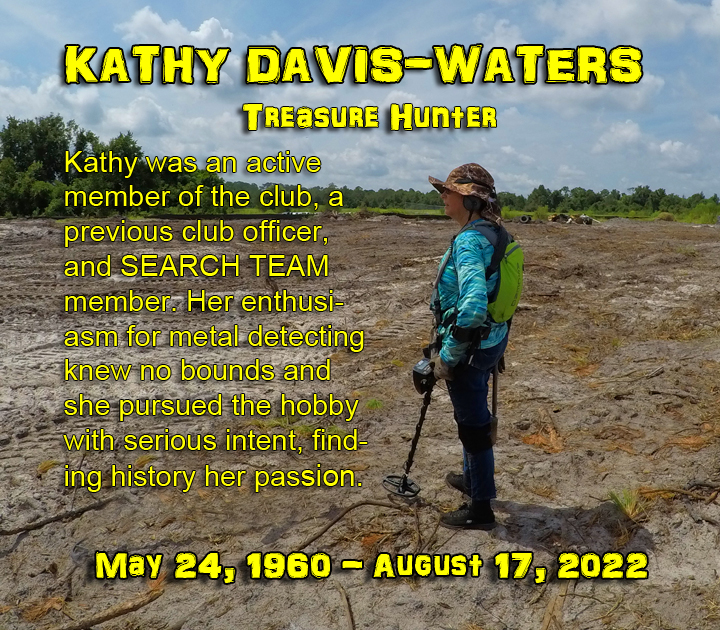
Kathy Davis-Waters - Goodby to A Friend

Kathy Davis-Waters was a friend of mine, and a member of the CFMDC since 2014, and had an active hand in the club and its activities, having been a club officer (vice-president), and a member of the club within the club, hunting police evidence, with the CFMDC Search Team. Cancer took her in mid-August, something we all knew was coming, including her. We were all hoping that, like in a TV show, there would be some last-minute plot twist that would erase the evil disease and bring her back to us in full health again, smiling and joking, doing her best to enjoy continuing life and her joy of God, friends, and metal detecting. Alas, it was not to be, and we sadly bid our friend goodby on the morning of August 17th 2022 where she passed peacefully into the arms of our Lord. 

Kathy Davis-Waters Treasure Hunter


Kathy Holding An Air Inlet Door from a WWII Grumman TBM Bomber

Kathy spent as much time as she could on small metal-detecting expeditions with all members of the group, and was an ardent detectorist. Her love of history always shown through with her various finds, and her excitement was palpable every time. One of her most spectacular recoveries, in my opinion, was a 1916 brass tire gauge that still showed signs of being serviceable over 100 years later! Unfortunately we had agreed to turn over all artifacts to the property owners after the hunt and she had to let her precious find go, a part of being in the hobby, but not particularly liking it. 

Kathy being Kathy...getting the "Kathy" stare 

 She was a master of many trades; she had been a Disney World photographer for many years, a private wedding photographer (her stories were priceless!) worked as a Uber and Lyft driver, but being a photographer was foremost. The other was detectorist. 

Kathy asking the farm owner where he thinks the $4000 diamond-studded cross might be

Kathy took part in many of the CFMDC Search Team's evidence hunts, lending a hand to put dangerous criminals where they belonged, behind bars or worse. She served as club Vice-President for one term, doing her best through cancer treatments to assist and support the club and the people in it. 

Proudly Displaying A Spoon Found On An Airbase Hunt

Kathy was a treasure hunter, and a good one. She originally used a Garrett AT-Pro, which she thoroughly wore out, upgrading to a Minelab CTX 3030. I hunted with her on many occasions and we always had a good time. Finding things was usually secondary to the fun we were all having!

Kathy (far left) my wife Patti, Me, and Mary hunting a Florida Park

We will all be missing Kathy's smile, her pranks (like yelling "GoPro STOP recording!" as she walked by) and her friendship, as she can never be replaced in our hearts. Rest in peace, Kathy.


Tuesday, June 28, 2022

Rewarding Hobby-Dealing With Gratitude

 Something I've noticed for many years now, is the conclusion to a successful lost ring, lost jewelry, lost necklace, pendant, and so on hunt is the happiness of the person who thought they would never see this item again. Hand over open mouth, jumping up and down, heartfelt hugs and the plethora of body language with verbal exclamations that go with the realization that your electronic magic wand has turned an unfathomed loss, into an unbelievable reunion! Here, at this point, is where the rubber meets the road. The person, or couple, or family holds out their hand with a wad of bills...maybe $20 or can go as high as $1000 at times and everywhere in between. The sudden quiet is deafening, the birds are frozen in flight, the world has momentarily stopped turning.

My Wife Returning A Lost Wedding Band

As part of our prime directive, our detectorist mantra, we never ask for a reward, but if one is offered? You, of course, are above all that, and your benevolence shines with a nuclear radiance...sometimes blinding you to the situation as it really stands. "No, no. I was glad to find it...that's what we/I do as a service...no, no...!" Let me say this about that: there is nothing wrong with being magnanimous, especially when you consider the time it took you to find it, or the magnitude of the recovery. BUT when it was truly a herculean effort, say in a dirty muddy scummy side canal, or alligator infested pond, or several days of pounding the ground, the atmosphere changes. Your equipment is specialized and expensive, the experience and proficiency in using that equipment is a hard-to-find commodity and traveling to the site is getting more and more expensive. Yes, yes, you have a great retirement nest-egg, yes everyone admires your charity and holds you as a hero, and it may well be deserved, as I have seen time and again, detectorists selflessly even put themselves in danger to recover and unrecoverable heirloom. But I'm talking about not a physical daring-do, but the mental state of the person who experienced the loss then the miraculous recovery. They really want to reward you...they really do! No one wants to live in the shadow of debt of another, and they would like to see you have a nice dinner out, or a movie as a token of their thanks for what you did.

So, as they hold a reward in their outstretched hand, I would advise you to thank them profusely and take it! Let me explain, especially to those of you that are mentally accusing me of being a detection hooker!  Although it is not really quid pro quo, it comes close. They go away happy for the return of the unreturnable, and you go away happy, maybe going to dinner and see Maverick with your wife on their dime tonight. Or not...just consider it.